Industrialist Paper No. 8
The Trust Spiral
By Andrew Kornuta • 9 min read
One quality escape can lock a supply chain for years
This series argues that American manufacturing already exists as a national system, but that it's hard to query, hard to verify, and therefore hard to coordinate. This essay narrows to one claim about what happens when that verification fails:
After a single high impact supplier failure, buyers add controls that measurably reduce awards to first time suppliers, increasing supplier concentration, introducing opacity, and raising the probability that the next disruption propagates into schedule slips. Onboarding cycle time for new suppliers increases, and quote to award rate declines for non incumbents.
The mechanism is a compounding loop where distrust becomes policy and policy reshapes the network. And when I say trust here, I don't mean vibe or familiarity. Trust is the probability that a buyer will place a PO on a new supplier using only portable evidence.
Mechanism
A quality escape is a governance event, not just a defect. The buyer gets punished twice — first by scrap, rework, and field exposure, then by internal loss of credibility. The CFO sees warranty and rework. The program manager sees a ship date. The quality director sees a corrective action request. The sourcing team sees its own vendor choice as the root cause, even when the real cause was a missing control point in the work package.
That internal punishment is what changes behavior. New gates appear in the vendor packet. A certificate of conformance stops being enough; now you want material traceability, heat lot linkage, calibration records, and an AS9102 first article package with forms that match the drawing revision. Receiving inspection grows a longer checklist. The supplier questionnaire swells. An audit becomes mandatory for jobs that used to be placed on a reputation and a short phone call. Every one of those moves is rational inside the buyer's incentive stack, and together they are exactly how distrust becomes a compounding loop.
The loop closes because gates decide who is even allowed to compete. The first thing to fall out is the unknown domestic shop that could have done the job and doesn't have the right paper stack, or can't absorb the audit overhead, or can't afford to wait 90 days for onboarding. What survives is whoever was already inside the fence. Volume concentrates, schedules tighten, and the system gets more fragile, because a smaller set of nodes is now carrying more of the load.
The fear behind all of this is legible in the cost numbers. Cost of poor quality routinely lands in the double digits of operations in "thriving" companies, and it goes far higher in bad cases. External failures are the most expensive of them, because they drag in returns, warranty, field rework, and lost credibility.
Evidence for generalists
I've watched the trust spiral run in shops that have lived through a quality escape. Before the event, a buyer issues an RFQ with a PDF drawing, a STEP file, and a note block that says "finish per spec." A supplier quotes it with a couple of clarifying questions, takes the PO, ships parts, and sends a basic cert. After the event, the same buyer issues the same drawing, and now the RFQ arrives with a supplier quality manual, a 30 page questionnaire, insurance requirements, mandatory first article inspection, process change notification rules, and a demand that the supplier use one specific format for FAIR documentation.
If you want a concrete illustration of why buyers do this, go read incident style reports and oversight memos from safety critical industries. Trust me, it makes for an exciting weekend. They point again and again at documentation control, training, nonconforming parts handling, and schedule pressure as contributing factors that degrade quality.
None of this comes from malicious buyers. It comes from incentives. When schedule pressure spikes, the procurement team stops optimizing for optionality and starts optimizing for defensibility, because the safest supplier is the one you can explain in a postmortem and the explanation gets built out of artifacts. Defensible buying wins over exploratory, innovative, or even cost-saving buying. Wanting to avoid the next quality escape is completely understandable. The trade-off is just much harder to see unless you go looking for it.
Evidence for builders
The loop is easiest to measure in work package artifacts and RFQ logs. Pull the supplier onboarding checklist from before the last significant escape, pull the current one, and count the deltas. New required fields, and a list that has become arduous. On the shop side, the traveler grew signoff boxes, in-process inspection steps expanded, and the CMM report became a required attachment to the ship packet even for low risk features.
There's a documented pattern in aerospace and defense quality work: quality escapes often originate at the control points that were supposed to prevent them, and first article inspection is the usual suspect, particularly when it's treated as paperwork instead of verification. Weak first article produces rejected parts and escapes, and buyers respond by tightening the gate — which is the loop again, one turn further along.
Now connect that to supplier concentration and fragility. Narrowing an approved list is choosing a network topology, whether or not anybody frames it that way. GAO has repeatedly flagged the consolidation of supplier bases and the emergence of single source dependencies as a risk, including in defense industrial contexts where lower tier consolidation reduces competition and increases vulnerability. The academic version of the same idea is that supply relationships can amplify shocks, and small degradations in relationship functioning propagate widely through the network.
The Prime concentration problem
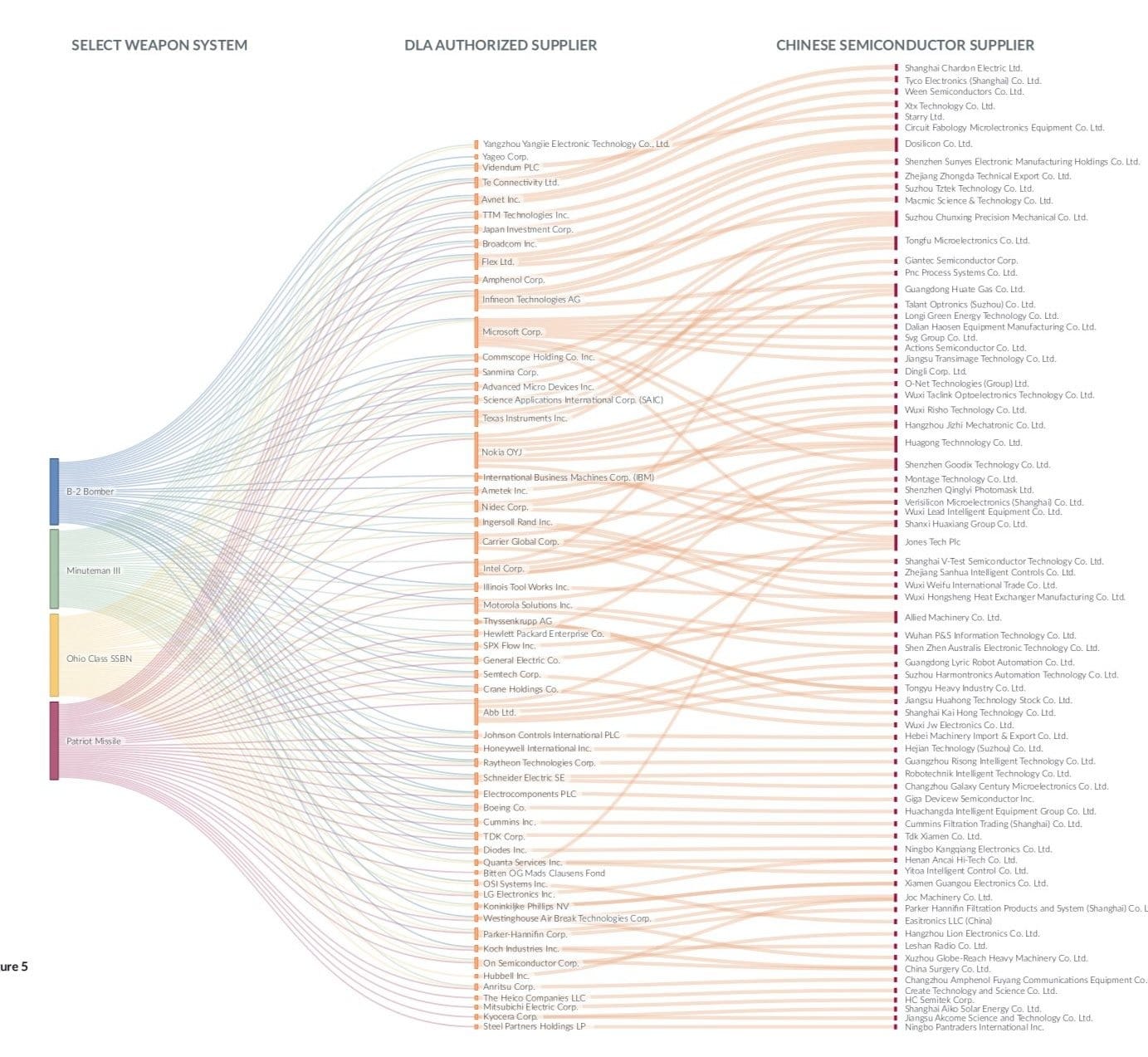
This well-circulated diagram represents one of the paradoxical outcomes of the trust spiral: solving for control producing a loss of control. Selected weapon systems on the left, "DLA Authorized Suppliers" in the middle, and a long tail of Chinese semiconductor suppliers on the right. In Govini's analysis, systems like the B-2, Minuteman III, Ohio class SSBN, and Patriot show purchasing paths where an authorized channel still maps to Chinese semiconductor firms upstream. The detail that matters is what the Prime can prove at award time. It can point to an approved supplier record and a compliant ship packet. It often cannot point to the sub-tier fabrication site that built the die, masked the wafer, or packaged the part. The trust artifact sitting in the Prime's file is a name in the middle column, and the actual production chain sits one step past the end of the Prime's line of sight.
The trust spiral is what produces that topology. After a quality escape, the Prime narrows who it will onboard and shifts buys toward large, already legible suppliers, because procurement can defend those decisions in a review with evidence that fits one: approved status, audit history, a closed corrective action on a prior NCR. Demand concentrates into Tier 1 integrators who are paid to deliver a schedule and a clean narrative, and they become the risk sink for the Prime's anxiety. Under margin and ship date pressure, the integrator's rational move is to preserve the outward paperwork while sourcing sub-tier capacity wherever it exists, because the Prime is evaluating the ship packet and not the factory floor. When the evidence boundary stops at the integrator, all that control effort doesn't remove chaos. It pushes it downward until the substitution is invisible.
Real incidents show how clean paperwork coexists with bad provenance. In 2024, regulators investigated titanium used in Boeing and Airbus jets after reports that falsified or incorrect documentation was used to verify authenticity, with Spirit AeroSystems acknowledging that suspect material had entered the supply chain via counterfeit records. The metal largely tested as the right alloy. The documentation chain was what got compromised, which is precisely the point: a parts system can pass every mechanical check and still be a governance failure, because traceability is the trust mechanism. Defense electronics has a longer history with the same failure mode, where counterfeit parts from China were found in military systems and procurement responded by tightening controls that often emphasize paperwork compliance while the underlying sourcing paths stay complex and indirect. The Prime concentration problem is that these responses increase dependence on fewer intermediaries, and intermediaries are exactly where provenance can blur without the ship packet ever breaking.
The operational consequence is perverse. The harder a Prime works to reduce risk by shrinking its direct supplier set, the more hidden sub-tier exposure it takes on, because each surviving Tier 1 carries a deeper vendor stack inside its deliverable. The Prime sees a cert packet and an AS9102 package. It does not see whether the upstream component was substituted, whether the traveler reflects the real process, or whether the inspection plan was written for the actual manufacturing route. That's why the diagram matters. It's a picture of trust being laundered through authorized channels, with the Prime's controls staying locally consistent while the national supply chain reality drifts, one procurement hop at a time.
Implications
Let distrust keep compounding and supplier entry becomes a paperwork problem instead of a capability problem. The nation keeps shops that could build the parts out of the award path entirely, because they can't clear the gate, even when their machines, fixtures, and metrology are perfectly adequate.
Supplier concentration rises, because fewer nodes can accept the compliance overhead. And as concentration rises, any disruption — a quality escape, a late shipment — has a larger blast radius, which increases the perceived need for even tighter controls.
Local efficiency investments show diminishing returns when they don't change external trust. A shop spends a year tightening quote cycle time in a new ERP, and the RFQs arriving are still low intent and non-repeat, because the shop isn't discoverable to buyers outside its incumbent circle. The estimator workload moves. The award rate doesn't.
A practical coordination layer would treat trust as an evidence object. I'd have it bind identity to RFQs, bind revisions to drawings, bind ship packets to cert packets, and expose consequence driven history — late ship codes, NCR closure quality, response discipline — in a format a buyer can audit without launching a custom onboarding project.
Outro
National self sufficiency takes more than capacity. It takes a buyer being able to place a PO on a new domestic supplier with the same confidence he has in his incumbent, using evidence that is portable and hard to fake, and — perhaps most important — evidence that's actually tied to the part rather than to the output of a team of quality control experts and auditors.
The practical failure mode is distrust. It looks like a swelling vendor packet, longer onboarding lead times, and a shrinking award funnel that concentrates work into fewer hands while making the actual origins of parts and materials harder to see.
In Paper 9 I take the next step: why trust can't be inferred from profile pages or directories, and why verification has to attach to work artifacts like RFQ completeness, revision control, inspection records, and ship packet closure codes.
Questions for you
- After your last quality escape, what new items were added to the vendor packet, and how many of them actually reduce defect escape rate versus just increase defensibility?
- What share of awards in the last 12 months went to first time suppliers, and how did that share change after the last major NCR or SCAR?
- In your RFQ log, what is the no response rate, late quote rate, and clarification count per RFQ, and which requirements correlate with fewer qualified responses?
- For a shipped job, can you reconstruct the full evidence chain from drawing revision to traveler steps to inspection plan to CMM report to cert packet, without asking a person to explain missing context?
- Which suppliers are effectively single source today, and what is the measured lead time and schedule risk premium created by that concentration?
- If you tightened gates tomorrow, which capable domestic suppliers would be excluded purely by paperwork, and what would that do to on time delivery and price over the next two quarters?